Sustainability labels: EU upcoming legislative initiatives and key elements for a comprehensive & accurate methodology
Sustainability labels: EU upcoming legislative initiatives and key elements for a comprehensive & accurate methodology
Sustainability labels should guide consumers purchasing decisions by providing information about a product’s environmental and social impacts. In recent years, several initiatives have been developed aiming to communicate sustainability-related information in a simple and effective way. Following the publication of the EU Green Deal, and considering the growing consumer’ concern on their consumption’s footprint, the EU is now working to achieve a common reference vision.
Upcoming EU legislation
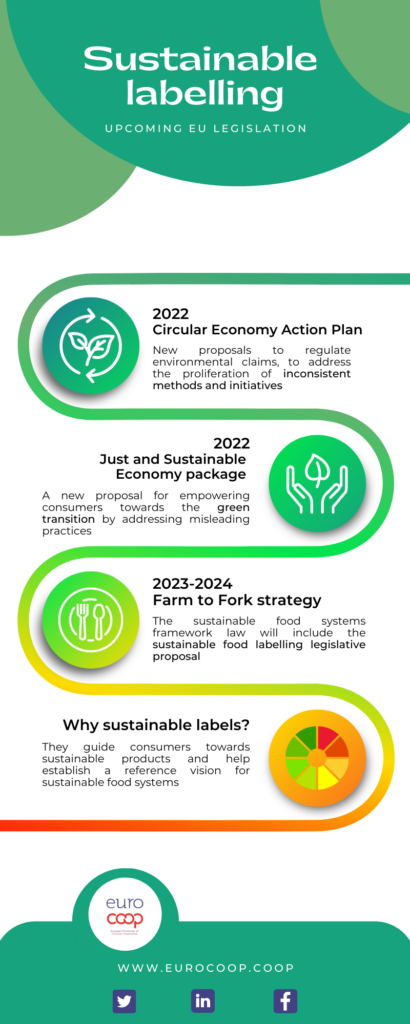
Although several provisions on sustainability labelling have already been approved in different sectors, such as energy and electronics, some sustainability labels- related issues still need to be addressed. To this extend, different points will be discussed within the framework of the:
- Circular Economy Action Plan (Expected in March 2022): as part of a new sustainable product policy framework, foresees proposals to regulate environmental claims, to address the proliferation of inconsistent methods and initiatives and too many misleading environmental claims
- Just and Sustainable Economy package (Expected in March 2022): a proposal for empowering consumers in the green transition to sustainability by addressing the untrustworthy information or practices preventing consumers’ effective contribution
- Farm to Fork strategy (Expected in 2023-2024): Sustainable food systems framework law will include the sustainable food labeling legislative proposal. It might be possible that the label will also have a link with GMO information to consumers
3 key objectives
Sustainability labels help consumers to make informed choices on the environmental impacts of products. In fact, recent scientific work has shown that sustainability labels can indeed be effective in guiding the consumer’s purchasing act . A credible and accurate label providing clear visual messages can positively influence shopping preferences towards better environmental performance.
In addition, sustainability labels encourage the eco-design of products: including environmental information could give higher quality products, new marketability and added value, since consumers can distinguish the least performing products from the more sustainable ones.
Choosing a specific labeling methodology should imply to firstly identify which methods of production are sustainable, hence to be further supported: that is the reason why it is crucial to create consensus on a definition of sustainable food systems. In this regard, a shared vision on sustainability labels would allow to guide methodological decisions that are consistent with planetary boundaries and to add new, relevant sustainability dimensions.
An accurate sustainability labels methodology
A comprehensive and accurate methodology should deal with:
- Clear visual labeling: consumers should easily assess the product’s sustainability profile thanks to a clear visual labelling.This should provide scores on its performance with respect to diverse sustainability aspects so that consumers could be able to choose products which meet their personal preferences and values
- Positive and negative impacts: an accurate scoring system should take into account both the negative and positive environmental impacts of a food product, in particular with respect to biodiversity, climate, human health & animal welfare
- Social sustainability: the labeling methodology should include indicators related to social sustainability issues, such as labour standards and human rights. Each product should report if its production and distribution are based on equitable processes, and support producers’ good quality of life
NGO joint letter on concerns over PEF methodology for agri-food products
On March, 7th 2022, together with 13 other NGOs, we sent an open letter to the EU Commission expressing our concerns about the Product Environmental Footprint (PEF) methodology that is currently being considered by DG ENV as a basis for the upcoming substantiating green claims proposal, that will also apply to agrifood products. The product-focused PEF was initially designed for industrial goods and we believe this is not adequate to assess the environmental performance of agri-food products.
In this context, we ask the EU Commission to base future sustainability labeling principles on robust methodologies giving unbiased information to consumers on environmental and social impacts of different production methods, in line with the Farm to Fork strategy.